

The Complete Guide to Getting a House Extension Under Permitted Development (and How Designers Can Avoid Planning Permission)
By Kieran Atherton – Architectural Designer, Director of Melrose Designs
Why This Guide Matters
If you’re a homeowner or an architectural designer, knowing exactly what qualifies as Permitted Development (PD) can save:
- £462+ in planning fees
- 8–10 weeks waiting time
- Costly redesigns
At Melrose Designs, I assess hundreds of extensions across Wigan, St Helens, Warrington and Greater Manchester every year. Most planning refusals could have been avoided simply by designing smarter within PD rules.
This guide explains every extension type you can build without planning permission and the practical tricks designers use to stay compliant.
Quick Links
Rear Extensions PD Guide → rear-extensions-permitted-development
Side Extensions & Wrap-Around Rules → side-extensions-permitted-development
Loft Conversions PD Rules → loft-permitted-development-guide
What Extensions Can You Build Without Planning Permission?
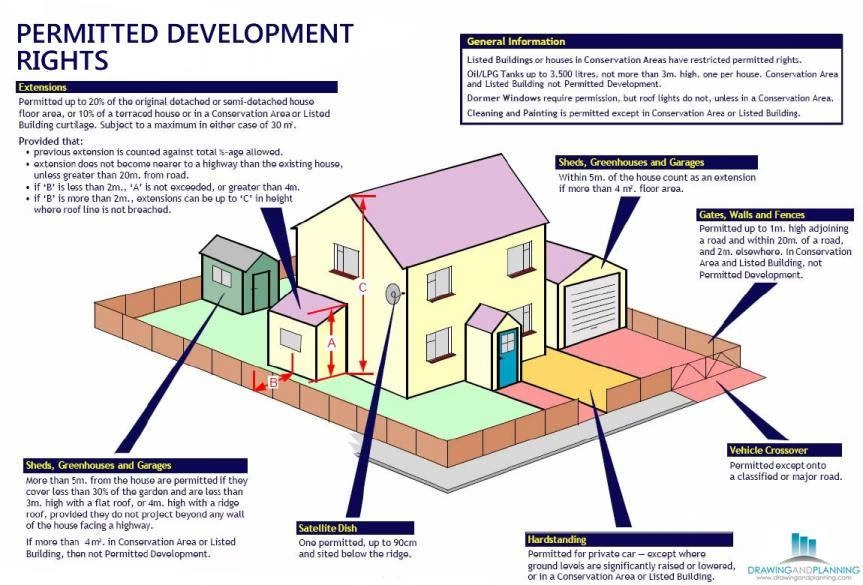
Under the Town and Country Planning (General Permitted Development) Order 2015 (as amended), you can build an extension without planning permission if it stays within national limits on height, projection, roof design, and materials.
In simple terms: an extension is PD if it is…
- Single-storey
- Within maximum depth limits
- Within height restrictions
- Using matching materials
- Subordinate to the original house
Permitted Development Extension Types (Explained Simply)
-
Single-Storey Rear Extensions
This is the extension most people build under PD.
Permitted Development Size Limits
House Type Max Depth (PA) Max Depth (Standard PD) Max Height Max Eaves Height
- Detached 8m 4m 4m 3m
Semi / Terrace 6m 3m 4m 3m
Designer Tips to Avoid Planning Permission
- Keep eaves under 3m near any boundary
- Consider a flat roof to control overall height
- Set the extension 150mm inside the boundary line
- Use roof lanterns / skylights to avoid raising the roof pitch
-
Single-Storey Side Extensions
Allowed under PD only if all conditions are met.
PD Limits
- Max height: 4m
- Max width: Half the width of the original house
- Single-storey only
- Must not join a rear extension → or it becomes a wrap-around, which is not PD
Designer Trick
If the side and rear extensions do not physically touch, they can be treated as two separate PD elements, avoiding the wrap-around restriction.
-
Loft Conversions & Dormers Under PD
Permitted Development Rules
- Max additional volume: 40m³ (terrace) / 50m³ (semi/detached)
- Dormer must be set back 200mm from eaves
- No extension past the front elevation (road-facing)
- Materials must be similar
Designer Tip
Use a hip-to-gable conversion to gain headroom first, then add a rear dormer to maximise space—both remain PD if volume is controlled.
Situations Where Planning Permission Is Still Required
Even if the extension meets PD rules, planning permission is required when:
✔ The property is in an Article 4 Direction area
(Some parts of Manchester and Salford remove PD rights.)
✔ The house is in a designated area
- Conservation Area
- National Park
- AONB
✔ The house was already enlarged beyond PD limits
PD only applies to the original house as built in 1948.
Designer Planning Tips (Proven on Real Projects)
- Check boundary heights using Google Earth
This allows you to check overlooking risks, roof angles, and existing extensions quickly.
- Speak to neighbours BEFORE drawings are submitted
In my experience at Melrose Designs, early neighbour support reduces objections by 70%.
- Produce 2 versions of the design
- Option A: Fully PD-compliant
- Option B: Planning version with added features
- Use low-profile roofs
Flat roofs with lanterns keep height within limits without losing light.
- Apply for a Lawful Development Certificate (LDC)
This legally confirms the work is PD—very important when the property is sold.
- Author Bio – Building Authority & Trust
- About the Author – Kieran Atherton
- Architectural Designer & Director of Melrose Designs Ltd
I specialise in home extensions, loft conversions, planning applications and Building Regulations drawings across Wigan, St Helens, Warrington and Greater Manchester.
Experience:
- 10+ years producing residential extension designs
- 1,000+ planning and PD drawings submitted
- Featured on North West renovation podcasts
- Professional BIM & structural coordination background
My goal is to make the planning process simple, predictable, and stress-free for homeowners.